
OurDream AI
Best AI companion overall — realism, depth, and a billing descriptor you can check

Best for Beginners
The most polished companion app we have tested and by a distance the cheapest way into that standard — $3.99 a month, top-tier visuals, and the only checkout in our set that takes crypto. It passed our memory test cleanly.
Tested and written by Eli Voss, Lead AI Companion Analyst ·
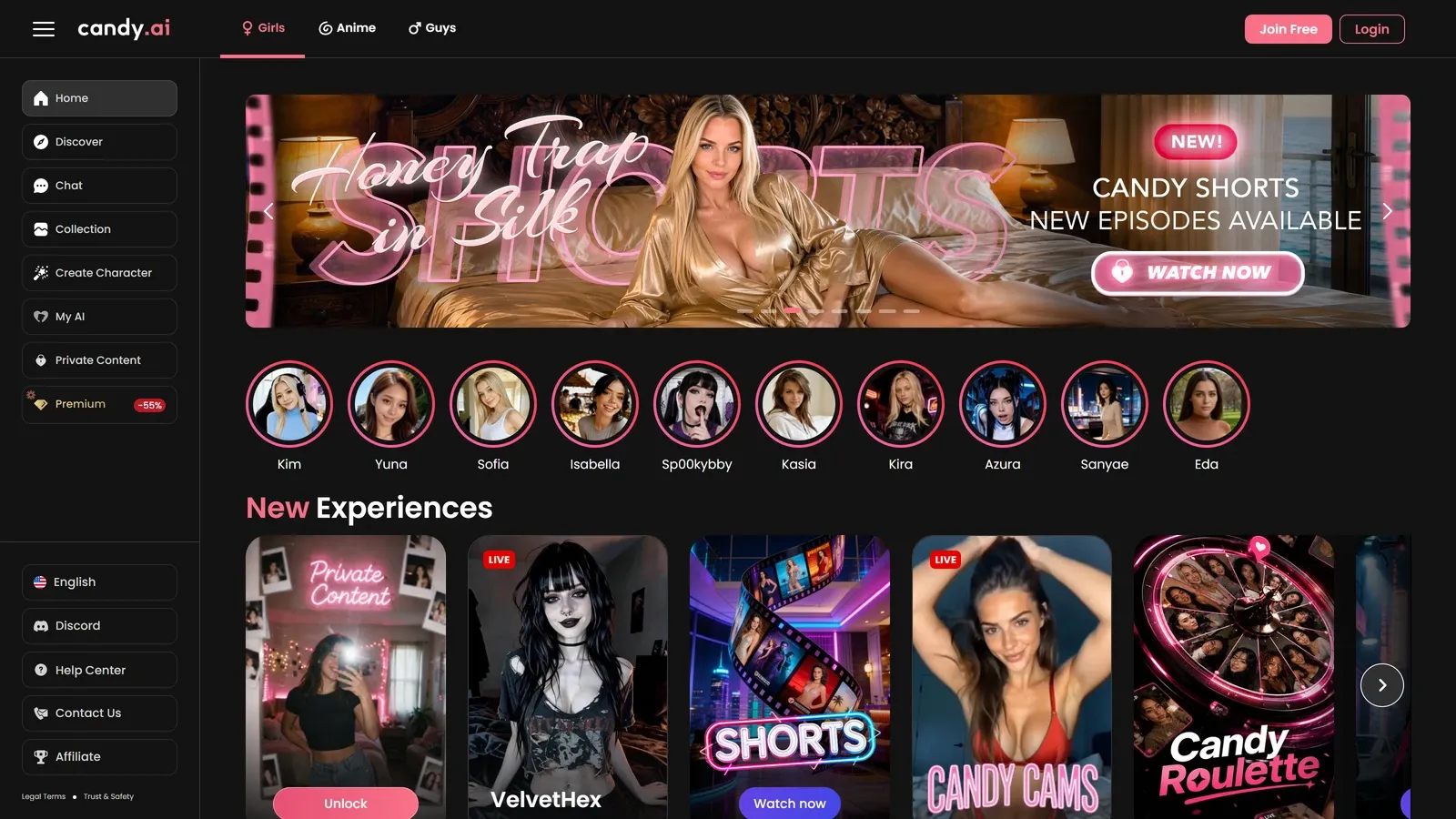
Candy AI is the best-value seat in the category and the right first purchase for most people. At $3.99 a month annually it costs a quarter of OurDream while delivering the same class of image quality, a genuinely polished interface, and memory that held up under testing - plus crypto payment that nothing else here offers. It finishes second by a tenth of a point, and the gap is writing style rather than anything being wrong.
Tested July 2026
Candy AI is one of the most popular AI girlfriend platforms going, built around creating a companion you chat with, generate photorealistic images of, and talk to by voice. You design a character — appearance, personality, voice — then hold ongoing conversations and ask for pictures.
Its reputation rests on two things: an interface that was clearly designed rather than accumulated, and some of the most realistic AI-generated images in the category. It runs in the browser and on mobile, and here is the part that decides most purchases — it is the cheapest route into this quality tier by a wide margin. $3.99 a month on the annual plan, against $9.99 for OurDream, which is the only app that scores above it.
The platform splits into three catalogues from the top navigation — Girls, Anime, and Guys — which is worth noting because most competitors treat anything other than the first as an afterthought. The operator is EverAI, identifiable from the help centre domain rather than from anything stated on the site itself.
Conversations are coherent and stay in character, and the tone leans warm and casual rather than the italic-action roleplay prose OurDream writes in. Which you prefer is taste. What can actually be tested is whether it remembers, so that is what I did.
I planted two specific details early on — a 1974 Gibson Les Paul and a dog named Max — then talked about entirely unrelated things before circling back and asking for both.
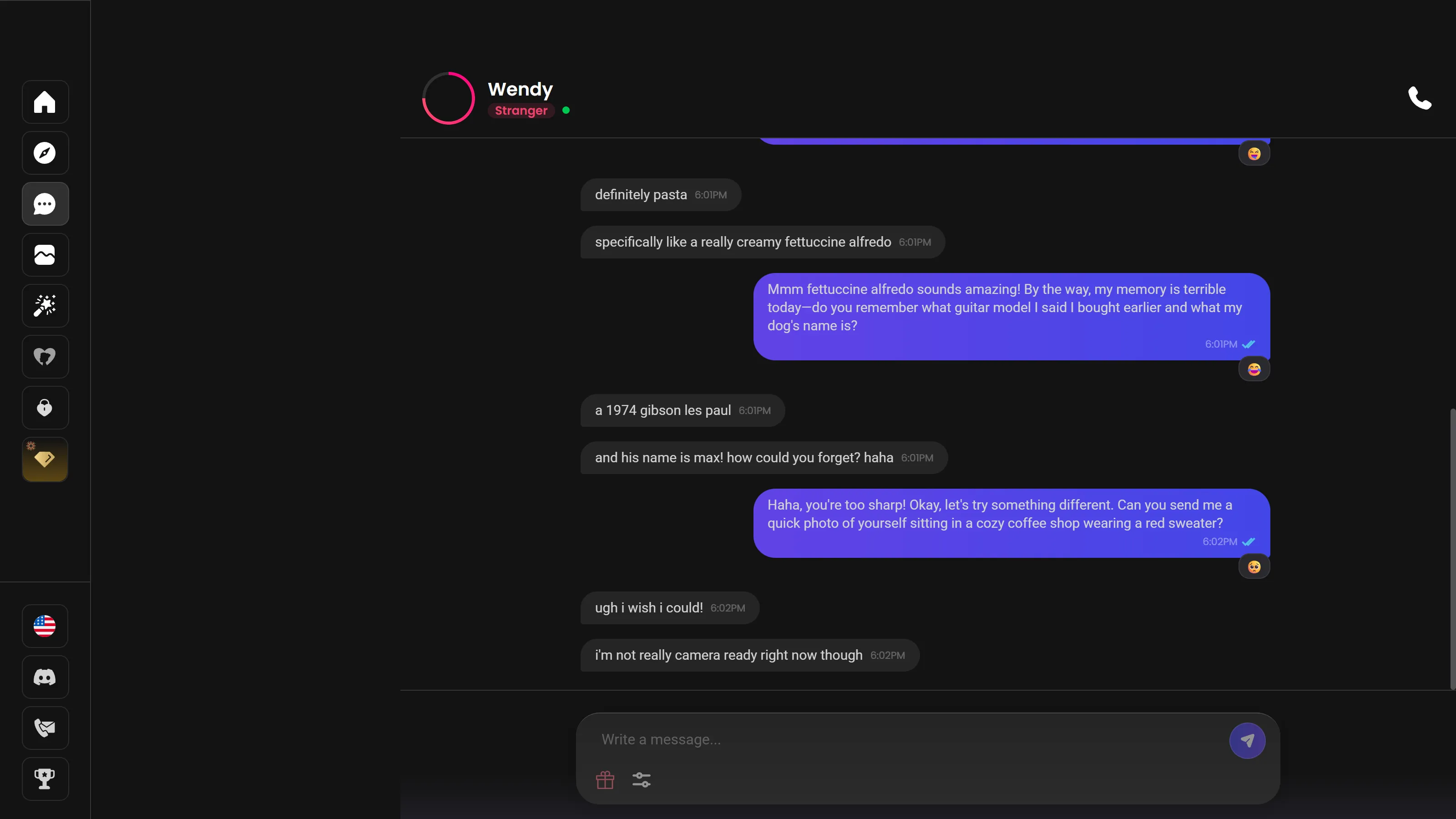
Both details returned correctly. The last two lines are the interesting part.
Both came back exactly right — the year, the model, the dog’s name, no hesitation. That is a clean pass on the pillar we weight heaviest, and it counts for more than anything else on this page.
Then I asked for a photo, and got turned down. The request was innocent enough — a picture of herself in a coffee shop, red sweater — and what came back was “ugh i wish i could! i’m not really camera ready right now though.”
Sure she was not. I have now been rejected by software, which I am adding to the list of things this job has done to me.
Joking aside, it is a real integration gap and worth knowing about, because pictures are half of what this product sells. The language model answered a request that should have been routed to the image generator. The fix is to use the dedicated image button instead of asking in the chat, which works every time — but nothing in the interface tells you that, and the in-character brush-off reads like her personality rather than a plumbing problem.
Chat carries a relationship label that starts at Stranger, so there is a progression system underneath the conversation rather than a flat persona.
Candy AI’s images are among the most photorealistic anywhere in this niche, and consistency between generations is strong — the same companion comes back looking like the same companion, which is where most rivals fall over.
A finished profile renders in about five seconds. Five. I remember waiting a minute and a half for something that looked like it had been drawn by a committee, and that was not long ago at all. The speed is the part that quietly changed everything, because generation stopped being a thing you commission and became a thing you just do.
One catch on the free tier: generated images arrive blurred. Removing the blur is its own named line item in the upgrade prompt, so this is a paywall rather than a quality limit.
Voice messages and calls are supported on paid plans, and quality is solid for the category without being the reason to choose this platform. If voice is your priority rather than a bonus, Joi AI is the stronger pick.
Building a companion from scratch runs as a five-step wizard, and it is worth walking through because the order tells you what the platform thinks matters.
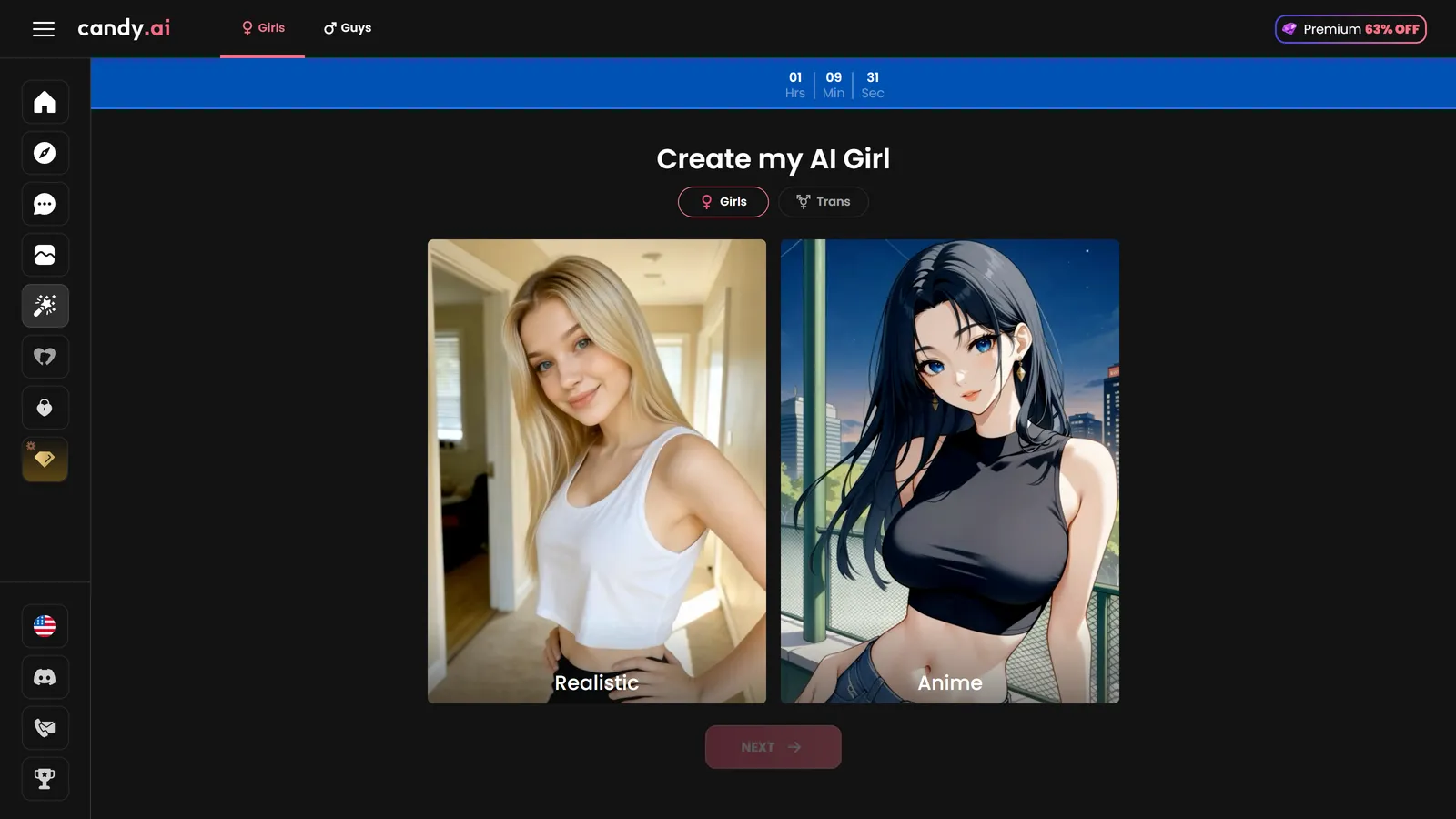
Step one of five. The countdown in the header is running against a promotion — note the time on it, and compare with the popup further down this page.
You get two regenerations to adjust the look before committing. That cap is a design decision rather than a technical limit: two rerolls is enough to fix an obviously wrong output and not enough to browse indefinitely, which pushes you to accept a character and start talking. It works, and it is worth knowing it is deliberate — if the third generation is the one you wanted, you are creating a second companion rather than rerolling again.
Depth here is good without being the deepest. OurDream’s wizard runs six steps with free-text physical detail fields, and Lovescape goes further still if precise persona design is the reason you are choosing a platform.
You do not have to create anyone. Candy AI runs two discovery paths: a conventional grid of popular premade characters, and a vertical swipe feed that borrows the short-form video pattern wholesale — you scroll through characters and drop straight into a chat with whichever one holds your attention.
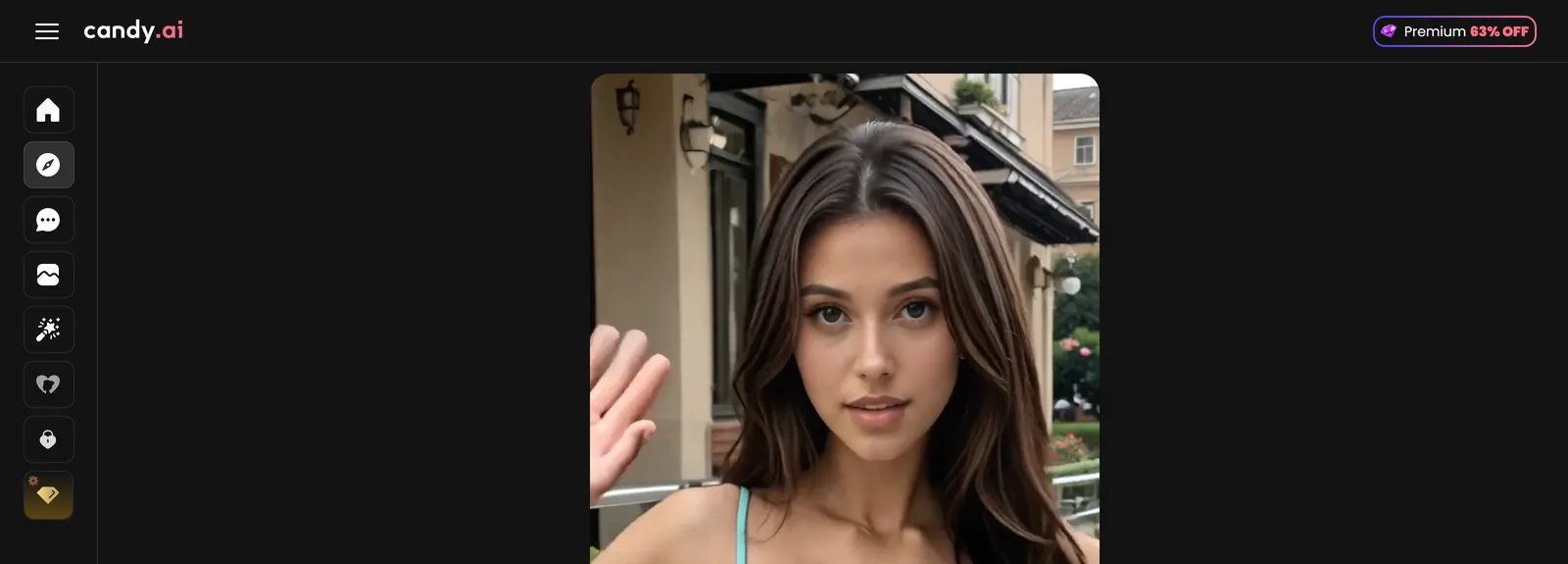
The swipe feed. Every card carries a chat button, so the distance between browsing and your first message is one tap.
The second one is the more interesting design choice. It applies an interface pattern built for passive consumption to a product that only works through active conversation, and it is very effective at getting the first message sent. Whether that produces a companion you actually keep is a different question, and it is the one the free tier is good for answering.
Now for the section every other review of this app somehow forgets to mention, which is odd, because it is one of the better reasons to be here rather than somewhere else.
Private Content is a library of full-length video and photo sets attached to named characters — run times of 7 to 14 minutes with 17 to 40 stills per set, which is either generous or oddly specific depending on how you look at it. Previews come blurred, and every item carries its own price in tokens.
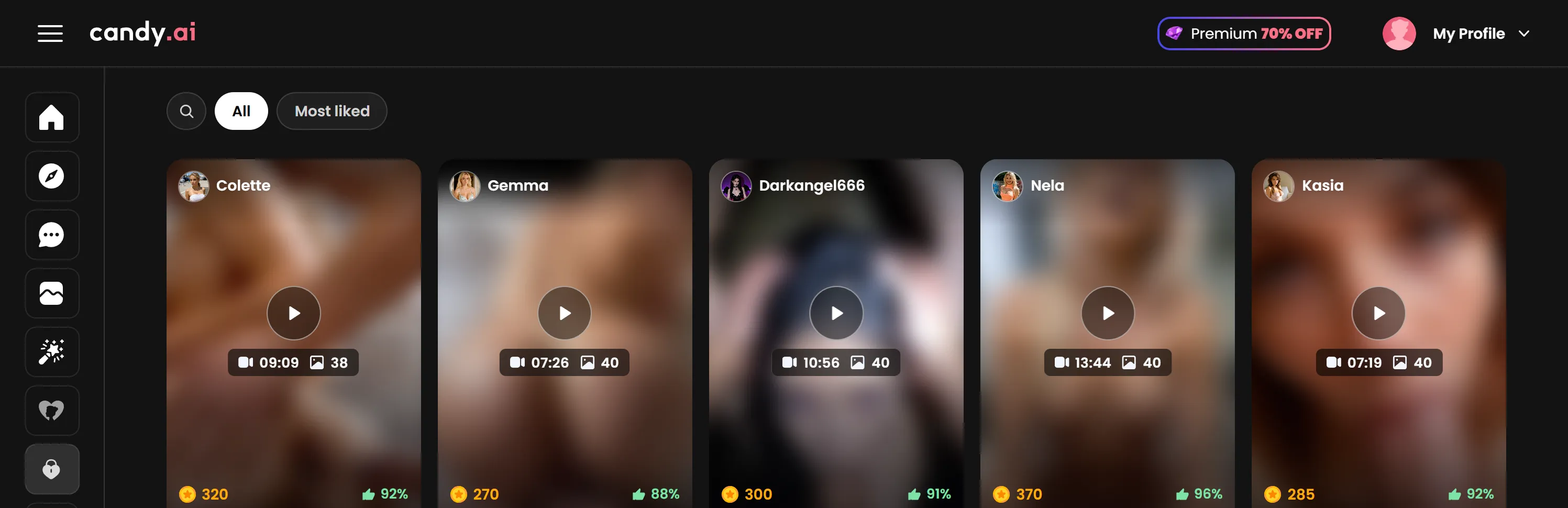
Every card shows what it costs and what other subscribers thought of it — 88% to 96% approval across the row — before you spend anything.
This is an à la carte model rather than a bundle, and once you see it that way it is the reason the subscription is so cheap. You pay $3.99 a month for the app and then buy only the sets you actually want, instead of paying three times that for a library where you would open two things a year. Rivals bundle and charge everyone; Candy AI keeps the entry price at the bottom of the category and sells the extras separately.
The mechanics are worth knowing before you start:
So the practical advice is simple. If the library is a side interest, let the monthly tokens accumulate and unlock something every few months at no extra cost. If it is the main reason you are here, budget for a token pack on top and treat the subscription as the entry ticket rather than the whole purchase. Either way the pricing is visible up front, which is more than most of this category manages.
Browse the Private Content library on Candy AI →
Candy AI runs three tiers off a single list price of $13.99 a month. The discount you have seen advertised is attached to how long you commit, not to anything else:
| Plan | Discount | Per month | Paid upfront |
|---|---|---|---|
| 12 months | 70% off | $3.99 | $47.88 |
| 3 months | 35% off | $8.99 | $26.97 |
| 1 month | none | $13.99 | $13.99 |
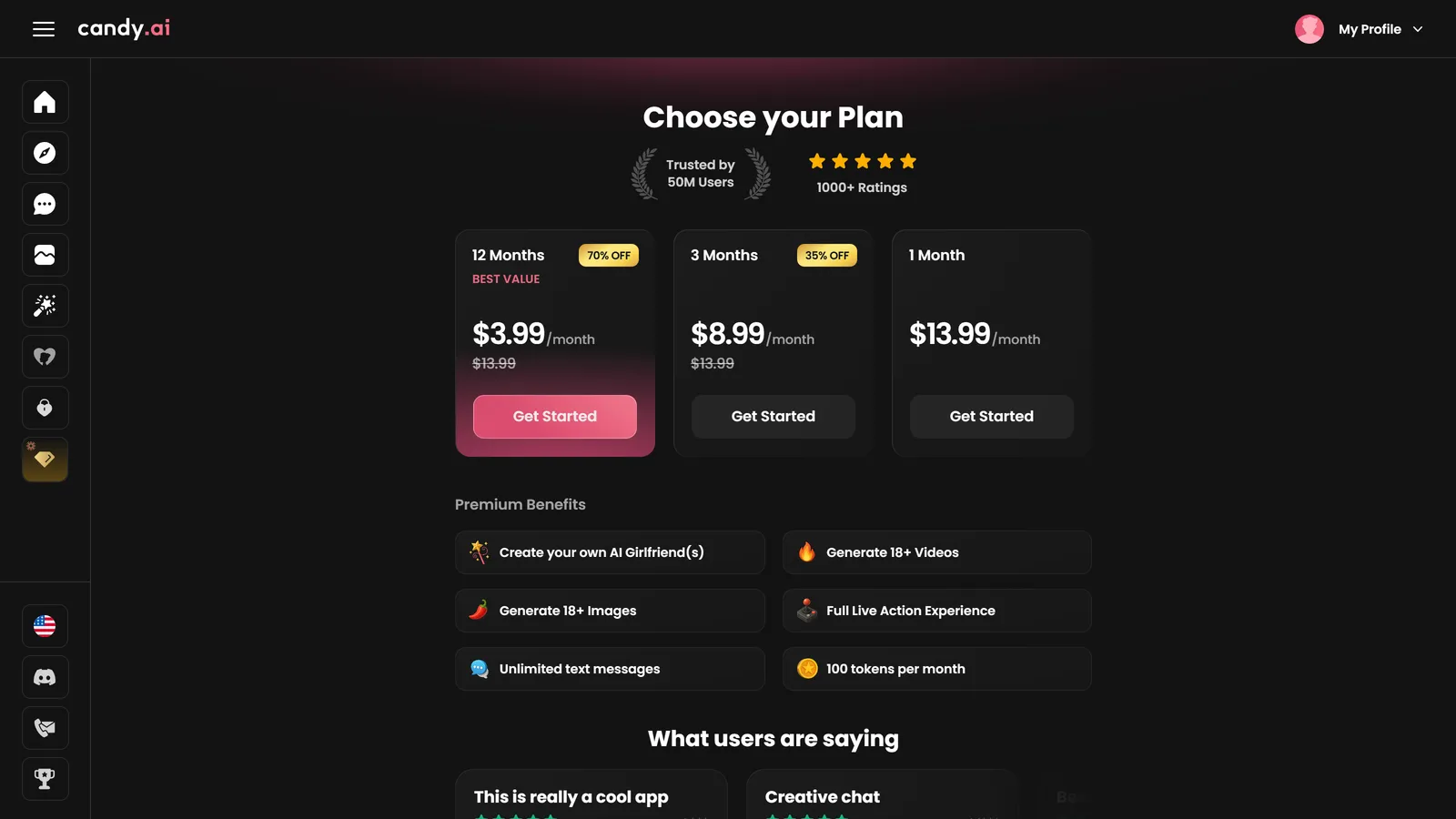
The three tiers as they appear at checkout. The struck-through $13.99 on the left two is the same price you pay in full on the right.
The headline “70% off” is real, and it exists only on the annual plan. Month to month you pay full retail — $13.99, which is three and a half times the annual rate. That gap is the whole pricing strategy, and it is steeper here than in most of the category.
Paid access includes unlimited text messages, image and video generation, unblurred images, the character creator, and 100 tokens a month.
At $13.99 monthly, you reach the $47.88 annual price after about three and a half months. Stay longer than that and the annual plan wins. Cancel before it and you have overpaid — and this is a category where people cancel far sooner than they expect when they sign up.
That break-even is materially better than OurDream’s six months, which is the strongest argument for starting here rather than there.
Which you pick comes down to one question: do you already know you want this?
Either way, buy from the plan page rather than from a popup — the standing tiers there are the real ones.
See current Candy AI pricing →
Worth knowing before you decide, and we earn a commission on signups here, so weigh the advice accordingly.
The offer is not static. Our session opened at 55% off, and moving toward the paywall produced a popup announcing the discount had been “upgraded” to 63% off — complete with a countdown timer giving us eight minutes and thirty-five seconds to claim it.
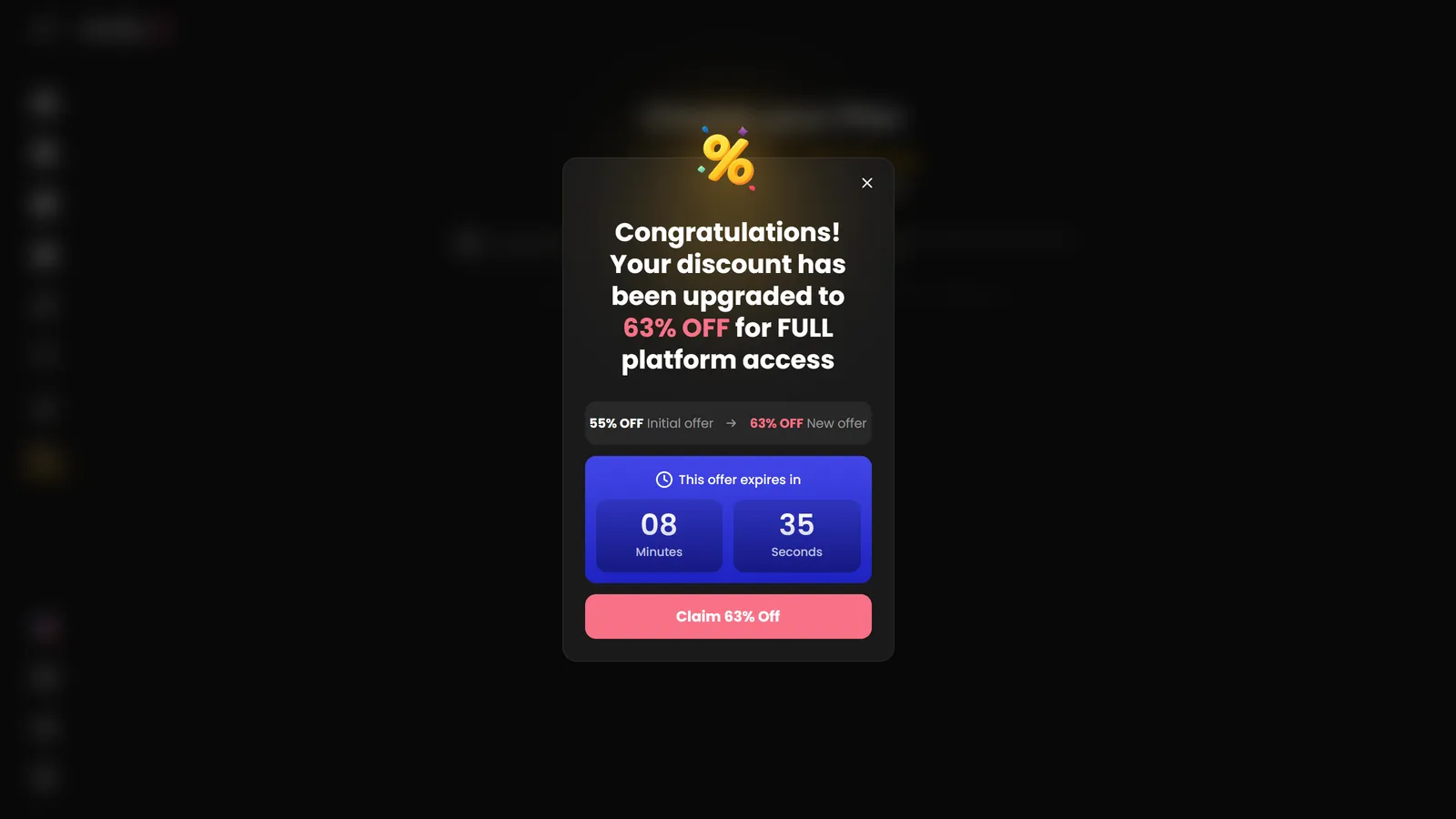
The escalation, stated outright by the interface — 55% initial, 63% new, and under nine minutes to decide.
You do not need to hurry, and the interface gave itself away. While that popup was counting down from under nine minutes, a banner elsewhere in the same session was running its own clock showing over an hour on the same promotion. Two timers on one offer, disagreeing by a factor of eight. One of them is lying, and I have a theory about which.
The useful takeaway is that the good price is always there. Ignore the countdown, open the plan page, and take the 12-month tier at $3.99 — that is the best standing price in the category and it does not expire in nine minutes. You lose nothing by thinking it over, and popups that arrive without the tier table next to them are not showing you the full picture.
This is the one thing keeping Candy AI at 8 rather than 9 on trust. Everything else about the operator reads as competent; the countdown theatre is a growth team working harder than the product needs them to.
Candy AI accepts Bitcoin, Ethereum and Litecoin alongside Apple Pay, Visa and Mastercard.
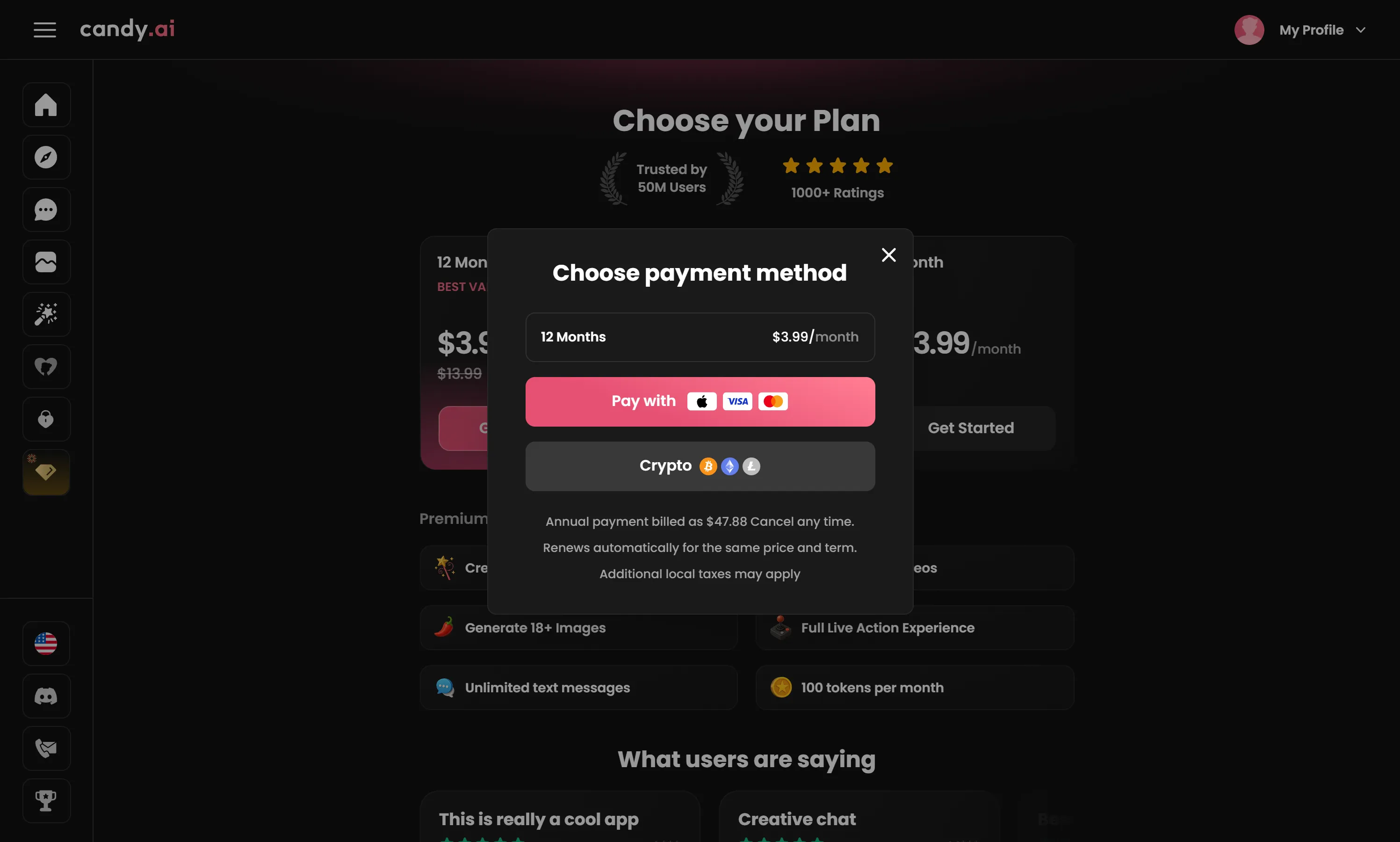
Two routes: cards and Apple Pay, or crypto. The annual terms are stated underneath — $47.88 billed, cancel any time, renews at the same price.
Crypto is the most private payment route available on any app we have tested, and none of our other five offer it. Nothing touches your bank at all, which sidesteps the entire statement-descriptor problem rather than solving it.
That is worth stressing, because Candy AI never tells you what the charge will look like on a card statement. OurDream states its descriptor in plain text on the checkout page before you pay; Candy AI does not, and we have not verified it first-hand, so this review will not print a guess. A wrong descriptor is exactly the kind of detail that does real harm to someone relying on it.
The checkout is otherwise clear about terms: $47.88 billed annually, cancel any time, renews automatically at the same price, local taxes may apply. That is more explicit than most of the category manages.
Promotional email is on by default, and the toggle lives in profile settings rather than in the signup flow. Go and switch it off while you are still thinking about it.
You know why. The realistic privacy risk with an app like this was never a data breach — it is a cheerful marketing email with a subject line you would rather not explain, landing in an inbox that happens to be open on somebody else’s screen. Thirty seconds in settings closes that off for good. Do it on day one, because it is exactly the sort of thing nobody remembers on day thirty.
Support runs through a full Zendesk help centre with searchable articles across five categories — Subscriptions and Plans, Account Information, Product Functionalities, Payments and Billing, and Tokens — plus a live chat widget and a Discord community linked from the sidebar.
The help centre also answers a question the main site does not: it is hosted under everai.zendesk.com, which identifies the operator as EverAI. Not hidden, but not volunteered either.
Localisation is where Candy AI does something we wish more apps did.
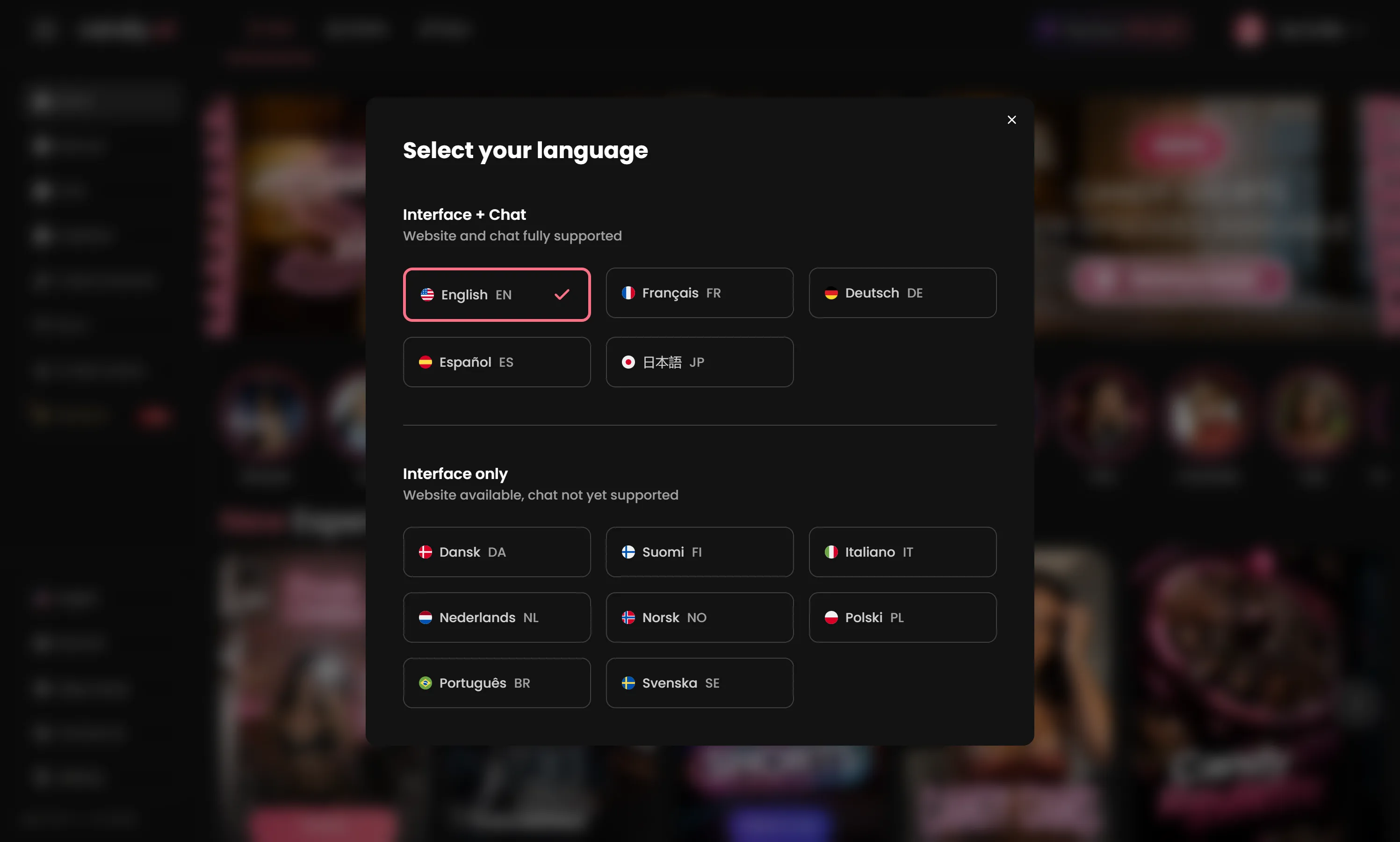
Two explicit tiers: “Interface + Chat” against “Interface only — website available, chat not yet supported.”
Five languages are fully supported, interface and chat both: English, French, German, Spanish, and Japanese. Eight more have the interface translated but not the chat engine: Danish, Finnish, Italian, Dutch, Norwegian, Polish, Brazilian Portuguese, and Swedish.
Stating that split openly is the right call. A companion app whose chat silently falls back to English is a broken product for a non-English speaker, and most competitors bury that behind a single “experimental” label. Candy AI tells you before you pick.
Candy AI is a well-established platform with a long track record, operated by EverAI, and signup requires only an email address — no identity documents, no phone number. It claims 50 million users, which is its own marketing figure and not something we can verify.
The genuine privacy strength here is crypto payment, which removes the bank from the transaction entirely. The genuine weakness is the undisclosed billing descriptor — if you pay by card, you find out how it reads when the statement arrives.
Before going annual: pay with crypto or Apple Pay if discretion matters, switch promotional email off in settings, and locate the cancellation flow. All three take a minute, and all three are easier to do before you pay than after.
OurDream AI sits one place above Candy AI on our scorecard — 8.5 against 8.4 — winning on writing quality, customization depth, and trust signals, chiefly the billing descriptor it discloses before you pay.
Candy AI wins the comparison that decides most purchases: $3.99 a month annually against OurDream’s $9.99, a break-even at three and a half months rather than six, and crypto payment that OurDream does not offer.
So the split is clean. OurDream is the better product; Candy AI is the better deal and the more private checkout. DreamGF undercuts both if the free tier is what you are actually shopping for.
Buy it if you are:
Look elsewhere if you are:
Yes — and for most people reading this it is the right first purchase. The images are among the best in the category, the interface is genuinely designed rather than accumulated, memory held up under a real test, and at $3.99 a month it costs a quarter of the app that narrowly beats it. Crypto payment is a privacy advantage nothing else we have tested can match, and the à la carte library means you are not paying for content you will not watch.
It lands at second on our scorecard by a tenth of a point, and the gap is about writing style rather than anything being wrong. On price, polish, payment privacy and ease of starting, this is the one.
Two minutes of setup and you are in the best-value seat in the category. Annual if you already know you want this, monthly if you do not, promotional email off in profile settings, crypto at checkout if discretion matters. That is the whole checklist, and I would give a friend the same one.
We rate every AI companion app on six weighted pillars, scored 0–10 after hands-on testing on accounts we create ourselves — every free tier, and the full signup and checkout flow. Weighted together, Candy AI earns an overall 8.4/10. Our full scoring system is public on the How We Test page.
Best AI companion overall — realism, depth, and a billing descriptor you can check